


Disclaimer: I own stock in Aluula at the time of writing. This content is not intended as advice of any kind
Imagine catching Gore-Tex, MIPS, or XPEL at the exact moment they pivoted from “cool niche tech” to “universal industry standard.” That is the inflection point currently facing Aluula.
Initially known as a high-end supplier for wind sports, Aluula is undergoing a radical transformation. They aren’t just selling wind sport material anymore; they are scaling a proprietary, adhesive-free manufacturing platform that produces materials up to 15x stronger than steel, yet light enough to float and 100% recyclable.
Before I go further, a special thank you to Meredith Brill for the initial exposure to the idea and for taking her time to speak with me about Aluula. She knows the business more than any other investor out there and when she talks, I listen. Check out her video pitch on Aluula. Now, on with the show…
Why the Opportunity is “Hidden”
At a ~$100M CAD market cap on $6M in trailing sales, the surface-level multiples might give a value investor pause. However, the real story lies in the “Lollapalooza Effect” brewing under the hood:
The Tech Moat: A “no-glue” fusion process that eliminates delamination and enables “no-sew” heat-welded construction.
The Scaling Milestone: The recent shift to industry-standard 1.5m widths, unlocking high-volume industrial and commercial markets.
Strategic Refocus: The divestment of their retail arm (Ocean Rodeo) to become a pure-play, neutral ingredient brand partner.
The Funnel: A massive backlog of active brands—including giants like Michelin—moving through an R&D pipeline that could drive a 10x revenue explosion.
With 45% insider ownership and a management team seasoned in global scaling, Aluula is no longer an R&D experiment, it is a manufacturing platform ready to disrupt the massive global textile and composites market.
"Three, four, five of these things work together, and it turns human brains into mush. And maybe you think this doesn't happen in picking investments. If so, you're living in a different world than I am"
- Charlie Munger, commenting on the lollapalooza effect
The Technology Overview
Ultra-High Molecular Weight Polyethylene (UHMWPE, or UHMW) is a thermoplastic polyethylene with extremely long molecular chains (2–6 million daltons), providing exceptional durability, impact strength, and wear resistance. It is significantly stronger than steel by weight, highly abrasion-resistant, self-lubricating, and chemically inert, making it ideal for industrial, marine, medical, and high-performance applications.
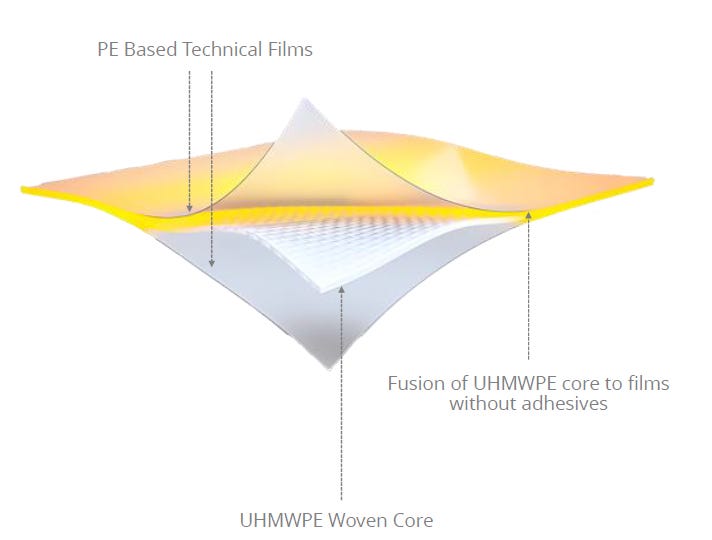
ALUULA’s moat is not the fiber, which can be sourced from various vendors, but the process IP (and trade secrets). By eliminating adhesives, Aluula has solved the “creep” problem (material stretching under load over time) that affects almost all competitive laminates. Furthermore, the company’s ability to offer a “monomaterial” solution positions it as the only supplier capable of meeting the rigorous circularity mandates (completely recyclable) being introduced in the EU and North American textile markets.
The foundation of Aluula’s competitive advantage lies not in the discovery of a new fiber, but in the invention of a superior method for bonding existing high-performance materials. The core constituent of Aluula fabrics is UHMWPE. While UHMWPE fibers are recognized for being up to 15X stronger than steel on a weight-for-weight basis, they possess a notoriously low surface energy, making them virtually impossible to bond using traditional industrial adhesives.
Traditional composite manufacturers circumvent this “non-stick” property by sandwiching UHMWPE fibers between layers of polyester film (PET) or other polymers, utilizing heavy chemical glues to maintain structural integrity. This approach introduces two fundamental weaknesses: delamination and environmental toxicity. Adhesives act as a point of structural vulnerability, often failing under the repetitive stress of flexing or extreme UV exposure, leading to the peeling of layers. Furthermore, the presence of these adhesives renders the material unrecyclable, as the disparate polymers cannot be cleanly separated at the end of the product’s life cycle.
All of this gives Aluula the unique advantage of making a unique material with the following intrinsic characteristics:
Lightweight
Strong
Avoids delamination (adhesive free)
Damage resistant (abrasion, puncture, tear)
Water proof / UV and salt resistant
Capable of holding gas
Unique in its look and feel (can be a positive or negative)
Fully recyclable (mono polymer)
The Manufacturing Platform Hook
The relationship to the end markets for Aluula’s material is simple but not easy. They are an ingredient in a brand partner’s design but the brand partner, who sells their products to the end markets, are not the manufacturer in most cases. Using Arcterix as an example, they use a trusted manufacturing partner who has to include Aluula in their production facilities and methods in order to incorporate Aluula as an ingredient.
This means that Aluula can be seen as a new platform that needs to be digested, incorporated, transitioned into the capability of the manufacturer’s equipment and processes. This isn’t as simple as changing out some equipment, it is a whole new process (heat pressed welding, not seems). There are some advantages to the transition of course, but it is a significant barrier to entry that is not a barrier the incumbent materials need to overcome.
“As a good rule of thumb, proprietary technology must be at least 10 times better than its closest substitute in some important dimension to lead to a real monopolistic advantage. Anything less than an order of magnitude better will probably be perceived as a marginal improvement and will be hard to sell, especially in an already crowded market.”
― Peter Thiel, Zero to One: Notes on Startups, or How to Build the Future
Is Aluula 10X better? This is the million billion dollar question…
