


"The report of my death was an exaggeration"
- Mark Twain

Constellation Software’s stock price appears as though it is on track to be a worthless corporate entity by the end of the year. The story of their demise then quickly follows suite. The classic “narrative follows price” is as evident now as it was when the stock was forever propelling higher year after year.
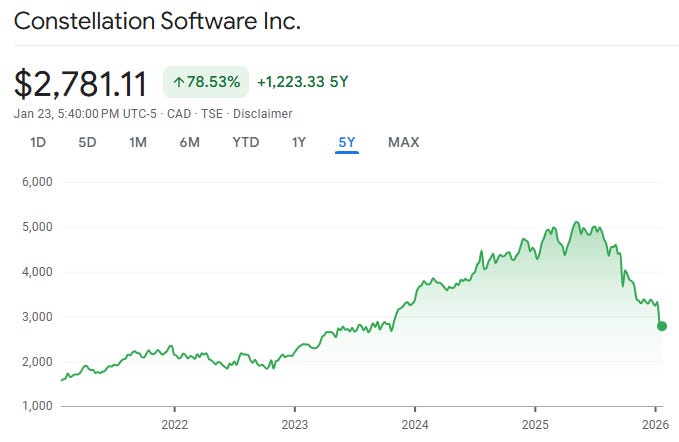
The truth about the quality of the business over the long term was and is somewhere in between these narrative extremes (it was and is a damn good business). CSI is not a business that can do no wrong, in fact they have made many mistakes over the years. The beauty in the culture and decentralized model is one in which they do measured experiments, share best practices, to learn, and fully take advantage of those mistakes as opposed to suffer deep consequences from them. Being an acquirer of small to medium sized businesses inherently offers this as a feature. No one acquisition (even the large ones) can wipe of the business in any meaningful way. No one vertical market, sector, geography, customer, industry, etc. can be a meaningful existential risk.
So SAAS Story Goes…
The prevailing narrative in 2026 is that the traditional SaaS business model is being “cannibalized” by AI. For two decades, software was valued as a high-margin tool that humans used to increase their own productivity, usually billed per “seat.” Today, that model is collapsing because AI agents are shifting the value from the tool to the task itself. We have entered the era of Software-as-Labor (SaaL), where the market no longer wants to pay for a subscription that a human must operate; it wants to pay for the “outcome”—whether that is a resolved customer ticket, a completed legal brief, or a processed invoice. This has turned general-purpose software into a deflationary commodity, compressing margins and threatening the “moat” of any company that lacks proprietary data.
AI and Acquisition Concerns: A major drag on sentiment is the perceived threat from AI, potentially reducing demand for legacy software or shrinking the pool of acquisition targets in vertical market software (VMS).
Counterarguments from investors note that CSU’s niche, regulated markets (e.g., utilities, transit) have slow adoption cycles, making disruption less imminent, and lower valuations could actually expand acquisition opportunities within CSU’s strict 20% IRR hurdle rates.
There’s speculation about share buybacks if the decline persists, which could signal confidence in compounding at high rates.
- From Grok on X: AI summary of investor sentiment and narrative regarding AI and its impact on CSI
The VMS Paradox: Stability in the Niche
While Horizontal SaaS (software for everyone) faces an existential crisis, Vertical Market Software (VMS), long considered the “boring” corner of tech, is emerging as the great AI-resilient holdout. The nuance lies in the “System of Record” vs. “System of Action” divide. While AI can easily replicate the action (writing an email or organizing a task), it cannot easily replace the record (the regulatory-compliant database and official workflow of a municipal water system or a specialized medical practice). VMS companies, such as those owned by Constellation Software, operate in tiny, “inch-wide, mile-deep” niches where the software is often legally or operationally “bolted” to the business. In these environments, the cost of switching is driven not by UI preference, but by the massive risk of data loss and regulatory non-compliance, making them remarkably immune to the “vibe-coding” startups currently disrupting the broader market. For years, CSI bears have pointed to “crappy” dated UI of many of the VMS offerings as evidence of the poor quality, when in fact this was argument of quality! The stickiness so high, even a dated windows 98 motif could not make companies move to alternatives. It was never about the code.
Constellation as a Capital Fortress
For a capital allocator like Constellation Software, the rise of AI is viewed less as a threat and more as a long-term efficiency filter. The current narrative suggests that AI makes software easier to build, which should theoretically invite competition; however, the VMS reality is that distribution and trust are the real moats, not the code. Constellation doesn’t buy “growth,” it buys “permanence.” or in some cases, just buys at such a low price, the durability of the product is not impactful to returns of the investment. In 2026, the narrative for VMS is one of “Defensive AI”: using agents to lower internal R&D costs and clean up legacy “unstructured sludge” (PDFs, logs, and manual records) to make their existing databases even stickier. While broad SaaS companies are forced to reinvent their entire billing structure to survive, the VMS model continues to thrive on the “structural monopoly” of being the only provider in a niche too small for Silicon Valley to care about, but too mission-critical for the customer to ever leave.
The question one must ask is something along the lines of one of the following:
“is the plumbing parts distributor going to vibe code an alternative to a product they know works already?” or
“is this 5-10 million niche vertical something worth competing with a new entrant just because anyone can code up a compelling new VMS?” or
“is the AI going to go and sell this code for me, to customers and verticals a new entrant likely doesn’t know as well as the incumbents?”
Valuation Review
With the current stock price at $2,700 CAD, the valuation for Constellation Software has moved into a significantly more attractive Margin of Safety zone (cheeky, I know). At this level, the market is pricing the business as if its best days are behind it. This could be a unique window for investors who understand the durability of Vertical Market Software (VMS).
Current Stock Price: $2,700 CAD
LTM Operational Cash Flow (OCF) per share: ~$170 CAD (Approx. $124 USD)
Implied P/OCF Multiple: 15.9x
Historically, Constellation has traded at a median of 25x OCF. Buying it at under 16x is essentially getting a “Quality-at-a-Reasonable-Price” (GARP) entry for what remains one of the greatest compounding machines in history.
5 and 10-Year IRR Scenarios
Assuming a starting OCF of $170 CAD/share and a current entry of $2,700 CAD, here is what your annualized returns (IRR) look like based on varied growth and exit multiples. This is not meant to be a complete in-depth valuation model for an investment from here but rather to give some broad view of possible outcomes, with some implicit assumptions regarding the stability of the business model relative to its own history. Obviously if you believe VMS is dead, these projections won’t be of any value and you would lose money.


Baby, Meet Bathwater
I truly believe AI tools and agents and whatever other end use we want to describe will be impactful to essentially all of business. And I don’t think I differ in my view on the large horizontal SAAS destruction that will likely have meaningful impacts on business models and products that businesses like Adobe, Workday, Salesforce and others offer. Where I do differ from some is about the distinction that VMS has in terms of the impact on businesses like Constellation.
Ironically, Constellation Software, much like Mark Twain and his sick cousin, has been mistaken as the same as the large SAAS winners that are under threat. And on a unrelated but somehow applicable narrative note, it was recently mentioned that the other Mark (Leonard) is expected to make a full recovery after stepping down due to health concerns. You can’t make this stuff up; a fitting narrative, indeed.
And if that analogy didn’t resonate with you, try this classic Monty Python skit on for size…”Bring out your dead!”
That’s it for now.
- Simon
Hey Simon - unfortunately what’s missing here is that OCF growth of 10% implies that CSU can still deploy capital at legacy ROICs. The business’ organic growth is in the low single digits, and the vast majority of topline growth (and therefore incremental flow through) comes from newly acquired assets. We are currently in likely the most competitive era for CSU to participate in acquisitive processes - highest number/variety of bidders (PE, CSU copycats, independent startups targeting LSD $m niches given the cratering cost curve for software development), highest perceived multiples by sellers (AI whitewashing + hot tech market has made people think their businesses are worth more than they are), and macro factors (tariff and rate environment likely makes it harder at the margin for CSU to push through their 20%+ price increases to customers in years 1/2). When you do some math on the amount of capital that needs to be deployed to achieve your OCF growth cases, you’ll likely start to be a bit more concerned
Thank you! Where was it mentioned that Mark Leonard was expected to make a full recovery?